| Beasts and Ballyhoo, The Menagerie Men of Somers |
| Town of Somers History |
J. Purdy Brown was a great innovator in moving his troupe around
and advertising their appearances in advance. A large part of the
public's circus experience was in the anticipation and arrival of the
event. Menageries had traditionally paraded their animals into towns,
either tethered or in cages on wagons that became increasingly
ornamented. Circus proprietors had little need for wagons prior to
the introduction of the tent, but with the example of the menagerie
showmen before them, and they soon joined the parade.
The brothers Benjamin, Christopher and Herschel Brown, cousins to
J. Purdy Brown, were involved with the menagerie business in the
early 1820's. Benjamin Brown (1799-1881) worked for Hachaliah
Bailey in the exhibition of Little Bet in 1823. He was employed by J.
Purdy Brown and Lewis Bailey in 1825, the season that the first
canvas tent was introduced. In 1826 Benjamin and Hershel operated
the Royal Pavilion Circus, (pavilion - being a euphemism of the time
for the canvas tent). Benjamin, Christopher and Hershel operated a
circus for their cousin, J. Purdy, in 1828. Brown's company was in
South Carolina performing when Charles Wright, another Somers
native famed as a lion tamer, came into town with his menagerie
troupe. The two companies appeared together, and as it seemed to
be successful, they performed the rest of the season together
becoming the first traveling combination of a menagerie and circus.
At this time, circuses were perceived as crude and, often morally
offensive. Menageries were considered educational and harmless,
and added respectability to the combination. The combination
formed the basis of the American circus, with this fortuitous beginning
with two Somers companies.
Benjamin Brown and many others traveled extensively exhibiting their
animals, ranging as far as the West Indies and South America.
Benjamin also traveled as an animal buyer for June, Titus &
Angevine, from nearby North Salem, the largest menagerie company
of the period. In 1838 Benjamin traveled to the Great Kalahari Desert
in Africa with Stebbins June, to purchase giraffes.
and advertising their appearances in advance. A large part of the
public's circus experience was in the anticipation and arrival of the
event. Menageries had traditionally paraded their animals into towns,
either tethered or in cages on wagons that became increasingly
ornamented. Circus proprietors had little need for wagons prior to
the introduction of the tent, but with the example of the menagerie
showmen before them, and they soon joined the parade.
The brothers Benjamin, Christopher and Herschel Brown, cousins to
J. Purdy Brown, were involved with the menagerie business in the
early 1820's. Benjamin Brown (1799-1881) worked for Hachaliah
Bailey in the exhibition of Little Bet in 1823. He was employed by J.
Purdy Brown and Lewis Bailey in 1825, the season that the first
canvas tent was introduced. In 1826 Benjamin and Hershel operated
the Royal Pavilion Circus, (pavilion - being a euphemism of the time
for the canvas tent). Benjamin, Christopher and Hershel operated a
circus for their cousin, J. Purdy, in 1828. Brown's company was in
South Carolina performing when Charles Wright, another Somers
native famed as a lion tamer, came into town with his menagerie
troupe. The two companies appeared together, and as it seemed to
be successful, they performed the rest of the season together
becoming the first traveling combination of a menagerie and circus.
At this time, circuses were perceived as crude and, often morally
offensive. Menageries were considered educational and harmless,
and added respectability to the combination. The combination
formed the basis of the American circus, with this fortuitous beginning
with two Somers companies.
Benjamin Brown and many others traveled extensively exhibiting their
animals, ranging as far as the West Indies and South America.
Benjamin also traveled as an animal buyer for June, Titus &
Angevine, from nearby North Salem, the largest menagerie company
of the period. In 1838 Benjamin traveled to the Great Kalahari Desert
in Africa with Stebbins June, to purchase giraffes.

| Brown & Co.'s Circus, Jan 23, [1830], Broadside SHS 75.04.2 Gift of the estate of Florence Johnson |
June left a written account of traveling with the
animals and his illness resulting from being bitten
by a lion. Brown also wrote of his various
illnesses contracted while traveling in the desert.
Copies of his correspondence are in the Somers
collection. Brown & June returned to America with
five giraffes, which were exhibited in New York in
the summer of 1840.
In the fall of 1840 Brown took the giraffes to
England with the Van Amburgh Menagerie where
he met and married Mary Cops, the daughter of
the Keeper of the Royal Menagerie at the Tower
of London. He resided with the Cops family in the
Tower until 1844, the only American known to
have done so. As a wedding gift, the couple
received an elegant pianoforte, which they
transported to Somers and is now in the Somers
Museum.
After returning from Europe, Ben Brown traveled
one last season with Van Amburgh & Co., then
sold his portion of the menagerie to Gerard
Crane. Benjamin Brown was interviewed by the
New York Sun in his 79th year, and was dubbed
The Oldest of Showmen having spent the majority
of his life in the business.
Daniel, James and Charles Wright represent
another Somers family that was part of the
peculiar calling of the menagerie business. They
were raised just up the road from the Elephant
Hotel, where their father Micajah Wright operated
a tavern and inn. Daniel Wright (1790-1864)
toured the Midwest with menagerie companies,
finally settling in Ohio. James Wright (1799-1864)
traveled extensively in the south, and eventually
made his home in Alabama. Charles Wright
(1792-1862) gained renown as the first Keeper of
the Lions in America.
animals and his illness resulting from being bitten
by a lion. Brown also wrote of his various
illnesses contracted while traveling in the desert.
Copies of his correspondence are in the Somers
collection. Brown & June returned to America with
five giraffes, which were exhibited in New York in
the summer of 1840.
In the fall of 1840 Brown took the giraffes to
England with the Van Amburgh Menagerie where
he met and married Mary Cops, the daughter of
the Keeper of the Royal Menagerie at the Tower
of London. He resided with the Cops family in the
Tower until 1844, the only American known to
have done so. As a wedding gift, the couple
received an elegant pianoforte, which they
transported to Somers and is now in the Somers
Museum.
After returning from Europe, Ben Brown traveled
one last season with Van Amburgh & Co., then
sold his portion of the menagerie to Gerard
Crane. Benjamin Brown was interviewed by the
New York Sun in his 79th year, and was dubbed
The Oldest of Showmen having spent the majority
of his life in the business.
Daniel, James and Charles Wright represent
another Somers family that was part of the
peculiar calling of the menagerie business. They
were raised just up the road from the Elephant
Hotel, where their father Micajah Wright operated
a tavern and inn. Daniel Wright (1790-1864)
toured the Midwest with menagerie companies,
finally settling in Ohio. James Wright (1799-1864)
traveled extensively in the south, and eventually
made his home in Alabama. Charles Wright
(1792-1862) gained renown as the first Keeper of
the Lions in America.

| The Giraffâ, D.W. Kellogg & Co., c. 1835, Lithograph SHS 73.21.20 Dr. Hugh Grant Rowell Collection |
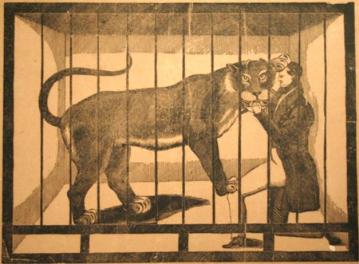
| [man believed to be Charles Wright in cage], Detail The Grand Caravan in Guilford, Connecticut, November 13 [1820] Wood engraving, W.W.Clapp, printer SHS 73.16.217 Dr. Hugh Grant Rowell Collection |