| Beasts and Ballyhoo, The Menagerie Men of Somers |
| Town of Somers History |
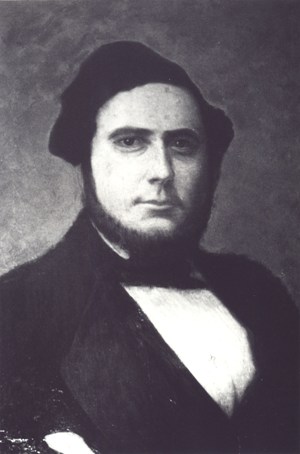
| Lewis B. Lent, c. 1870 Artist unknown, Oil on Canvas, detail SHS 97.40 Gift of Arthur McElroy |
Of the next generation of Somers showmen, Lewis
Lent (1813-1887) was born and schooled in the town,
his father Benjamin having been a partner of
Hachaliah Bailey's. Lewis grew up around menagerie
animals and his early shows featured many animals,
including the first troupe of camels in America. At age
13 he was already employed in the family business,
and soon after is recorded as working for June Titus
and Angevine. In 1834 he invested in J.R. & W. Howe,
Jr., & Co. menagerie (of North Salem). Using his
money, the firm purchased a half interest in June Titus
& Angevine's rhinoceros, polar bear, leopard & their
cages. In 1835, at the age of 22, he joined Brown &
Co. circus, with Oscar Brown, brother of and
successor to J. Purdy Brown. He became partner in
Brown & Co. in 1836, most likely with funds from father
Benjamin. Lent was a partner to Richard Sands, an
English equestrian, in 1846, and managed Barnum's
traveling menagerie in 1853-1854. Lent is one of the
early menagerie participants who crossed over to the
circus business. Lent has been described as a jovial
man and a huge one (over 300 pounds at his death),
who insisted on being in charge of every aspect of his
business operations- almost a sure sign of a
successful man.
Lent (1813-1887) was born and schooled in the town,
his father Benjamin having been a partner of
Hachaliah Bailey's. Lewis grew up around menagerie
animals and his early shows featured many animals,
including the first troupe of camels in America. At age
13 he was already employed in the family business,
and soon after is recorded as working for June Titus
and Angevine. In 1834 he invested in J.R. & W. Howe,
Jr., & Co. menagerie (of North Salem). Using his
money, the firm purchased a half interest in June Titus
& Angevine's rhinoceros, polar bear, leopard & their
cages. In 1835, at the age of 22, he joined Brown &
Co. circus, with Oscar Brown, brother of and
successor to J. Purdy Brown. He became partner in
Brown & Co. in 1836, most likely with funds from father
Benjamin. Lent was a partner to Richard Sands, an
English equestrian, in 1846, and managed Barnum's
traveling menagerie in 1853-1854. Lent is one of the
early menagerie participants who crossed over to the
circus business. Lent has been described as a jovial
man and a huge one (over 300 pounds at his death),
who insisted on being in charge of every aspect of his
business operations- almost a sure sign of a
successful man.
Lent partnered with Rufus Welch, the great circus entrepreneur from upstate New York in 1856. He
operated a successful railroad circus from 1866-1874 and was the proprietor of L.B. Lent's New York
Circus in 1871, quartered on 14th Street in New York City. P. T. Barnum bought out his circus on 14th
Street in 1872, but it burned to the ground in the first season. Lent went on to produce his New York
Circus, Museum, Menagerie, Caravan & Zoological Garden at the site of Madison Square Garden on
26th Street, also predating Barnum at that site. He died in New York City in 1887, and is buried in
Ivandell Cemetery in Somers.
operated a successful railroad circus from 1866-1874 and was the proprietor of L.B. Lent's New York
Circus in 1871, quartered on 14th Street in New York City. P. T. Barnum bought out his circus on 14th
Street in 1872, but it burned to the ground in the first season. Lent went on to produce his New York
Circus, Museum, Menagerie, Caravan & Zoological Garden at the site of Madison Square Garden on
26th Street, also predating Barnum at that site. He died in New York City in 1887, and is buried in
Ivandell Cemetery in Somers.
The menagerie men of Westchester and
Putnam Counties came to dominate the
outdoor exhibition business in the
northeast. On January 14, 1835 at
Somers, the menagerie men gathered at
the Elephant Hotel to form a capital stock
company called the Zoological Institute. Its
stated purpose was to more generally
diffuse and promote the knowledge of
natural history and gratify rational curiosity.
One hundred and thirty-five signatures are
on the articles of incorporation. The list
contained virtually all of the active
menagerie owners and managers in the
Northeast, as well as individuals whose
businesses relied on the shows, such as
Richard Hoe, a New York City printer who
made advertisements and posters for
circuses and menageries. The organizers
of the Zoological Institute set routes and
performance schedules, monopolizing the
business in the East.
Putnam Counties came to dominate the
outdoor exhibition business in the
northeast. On January 14, 1835 at
Somers, the menagerie men gathered at
the Elephant Hotel to form a capital stock
company called the Zoological Institute. Its
stated purpose was to more generally
diffuse and promote the knowledge of
natural history and gratify rational curiosity.
One hundred and thirty-five signatures are
on the articles of incorporation. The list
contained virtually all of the active
menagerie owners and managers in the
Northeast, as well as individuals whose
businesses relied on the shows, such as
Richard Hoe, a New York City printer who
made advertisements and posters for
circuses and menageries. The organizers
of the Zoological Institute set routes and
performance schedules, monopolizing the
business in the East.

| Zoological Institute Association Certificate, February 21, 1833, Charles Wright entitled to 120 shares in Zoological Institute stock The Caroline Wright-Reis Collection, Town of Somers |
With more than one hundred investors, the appraised value of the animals, equipment and real estate
was $329,325. They purchased a performance space in New York at 37 Bowery, which served as
winter quarters. The equipment and animals were organized into 12 companies, five of which included
circuses. The Association exercised a virtual monopoly on the animal show business. Some members
were known as The Flatfoots by those who challenged their leadership because they put their foot down
flat against any competitor bringing a show into the eastern territory. The company disbanded after the
financial panic of 1837, and its property was sold at an auction that took place at the Elephant Hotel on
August 22nd and 23rd, 1837. The name Zoological Institute was used for a number of years after by
exhibiting companies.
was $329,325. They purchased a performance space in New York at 37 Bowery, which served as
winter quarters. The equipment and animals were organized into 12 companies, five of which included
circuses. The Association exercised a virtual monopoly on the animal show business. Some members
were known as The Flatfoots by those who challenged their leadership because they put their foot down
flat against any competitor bringing a show into the eastern territory. The company disbanded after the
financial panic of 1837, and its property was sold at an auction that took place at the Elephant Hotel on
August 22nd and 23rd, 1837. The name Zoological Institute was used for a number of years after by
exhibiting companies.