| Beasts and Ballyhoo, The Menagerie Men of Somers |
| Town of Somers History |
Thayer notes intrigued neighbors rapidly turned Somers into a Mecca for entrepreneurs and wild
animals. When they weren't on the road, the animals were hidden away in local farmer's barns, some of
which are still standing.
Hachaliah Bailey served as a role model to a young P.T. Barnum, who wrote of meeting him when
Hachaliah visited Barnum's store in Bethel Connecticut. Barnum was surely aware of Hachaliah's
reputation as a successful menagerie owner, and apparently admired Bailey's entrepreneurial spirit.
Barnum recounts a tale extolling Hachaliah's method of settling accounts with an unscrupulous partner
who was exhibiting his elephant. Barnum later became involved with traveling exhibitions. introducing
human curiosities and extraordinary people like Joice Heth, the Siamese twins Chang & Eng, Tom
Thumb and Jenny Lind in his American Museum on Broadway, NY. Although renowned as a showman
and successful entrepreneur from the 1830's, P.T. Barnum never partnered with Hachaliah, as is
constantly misconstrued. Barnum did not get involved in the formal circus until 1871, and not until 1888
did he lend his name to a partnership with James Bailey, the adopted of Frederick, a distant relative of
Hachaliah's, to from the circus which continues to bear his name.
animals. When they weren't on the road, the animals were hidden away in local farmer's barns, some of
which are still standing.
Hachaliah Bailey served as a role model to a young P.T. Barnum, who wrote of meeting him when
Hachaliah visited Barnum's store in Bethel Connecticut. Barnum was surely aware of Hachaliah's
reputation as a successful menagerie owner, and apparently admired Bailey's entrepreneurial spirit.
Barnum recounts a tale extolling Hachaliah's method of settling accounts with an unscrupulous partner
who was exhibiting his elephant. Barnum later became involved with traveling exhibitions. introducing
human curiosities and extraordinary people like Joice Heth, the Siamese twins Chang & Eng, Tom
Thumb and Jenny Lind in his American Museum on Broadway, NY. Although renowned as a showman
and successful entrepreneur from the 1830's, P.T. Barnum never partnered with Hachaliah, as is
constantly misconstrued. Barnum did not get involved in the formal circus until 1871, and not until 1888
did he lend his name to a partnership with James Bailey, the adopted of Frederick, a distant relative of
Hachaliah's, to from the circus which continues to bear his name.
The Elephant Hotel
As a memorial to his elephants
Hachaliah Bailey built the
Elephant Hotel, on a piece of
land he had purchased from
Thomas Leggett in 1807 for
$1,250. Bailey broke ground
and built a brick stagecoach
inn which was completed by
1825. Across the facade of
the building were emblazoned
the letters ELEPHANT HOTEL.
In front of the building he
erected a tall granite shaft with
a small gilt carved wood
elephant atop it.
As a memorial to his elephants
Hachaliah Bailey built the
Elephant Hotel, on a piece of
land he had purchased from
Thomas Leggett in 1807 for
$1,250. Bailey broke ground
and built a brick stagecoach
inn which was completed by
1825. Across the facade of
the building were emblazoned
the letters ELEPHANT HOTEL.
In front of the building he
erected a tall granite shaft with
a small gilt carved wood
elephant atop it.
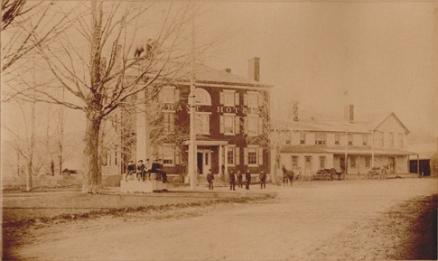
| View of the Elephant Hotel, c. 1880, Photographer unknown, Albumen? photograph, SHS collection |
The Elephant Hotel, fortuitously located at the intersection of the Croton and Danbury Turnpikes,
became an important stagecoach stop for the Eagle and Red Bird Lines from Westchester and Danbury.
The building served as a travelers inn, as well as a meeting place for the menagerie and circus folk that
populated Somers and surrounding towns. It was known as the best hostelry between New York and
Albany in stagecoach days.
Hachaliah Bailey served two terms in the New York State Legislature, then sold the Elephant Hotel in
1836 to Gerard Crane, another Somers menagerie owner, and moved his family to a place that became
known as Bailey's Crossroads in Virginia. Members of Hachaliah's family continued in the circus
tradition. His son Lewis often performed as a clown, and Lewis wife Maria as an equestrian. In the
1830's sons Joseph Todd Bailey and James Purdy Bailey toured the country as J.T. & J.P. Bailey & Co.
Hachaliah Bailey returned to visit Somers, where he died in 1845 and is buried in Ivandell Cemetery in
the hamlet. On his monument are written these words: Enterprise, Perseverance, Integrity; fitting
words for the spirit of all the early menagerie men. Bailey was an early impetus for the menagerie fever
which spread through the Eastern United States. As the menageries later accompanied and finally
became an integral part in the circus, he was acclaimed as the innovator in beginning the menagerie
tradition. No less a showman than P.T. Barnum paid him homage in his first of a series of
autobiographies in 1855. Stuart Thayer calls him the father of the menagerie business in America.(20)
And declares one was to choose a symbol of the menagerie business in America it would have to be the
Elephant Hotel in Somers, NY.
Numerous other townsmen became involved in importing exotic animals, managing traveling units, and
performing in the exhibitions. The first and most notable member of the Brown family was J. Purdy
Brown(1802-1834) who was born in Somers in a small house still standing near the Elephant Hotel. He
introduced several innovations which were momentous in changing the nature of public entertainment.
Since its introduction in 1793 in Philadelphia, the circus, originally equestrian and acrobatic exhibitions,
was performed in a closed circular arena of wood construction. Companies would play out their run in a
large population center, then tear down the structure and move on. Early menageries consisted of small
troupes of animals, traveling in crude wagons across rutted roads, stopping in taverns and barnyards to
exhibit in a controlled location where admission could be charged.
In his 1825 season J. Purdy Brown, with his partner Lewis Bailey (son of Hachaliah), introduced one of
the greatest innovations to the traveling show, around top or circular canvas tent 90 ft. in diameter.
Using a portable tent Brown could set up in small places between his major shows in metropolitan areas,
stay as long as business warranted, and then pack up his troupe and move on. The tent allowed him to
perform continuously and avoid down time between larger venues,(22) while bringing the entertainment
to small towns.
became an important stagecoach stop for the Eagle and Red Bird Lines from Westchester and Danbury.
The building served as a travelers inn, as well as a meeting place for the menagerie and circus folk that
populated Somers and surrounding towns. It was known as the best hostelry between New York and
Albany in stagecoach days.
Hachaliah Bailey served two terms in the New York State Legislature, then sold the Elephant Hotel in
1836 to Gerard Crane, another Somers menagerie owner, and moved his family to a place that became
known as Bailey's Crossroads in Virginia. Members of Hachaliah's family continued in the circus
tradition. His son Lewis often performed as a clown, and Lewis wife Maria as an equestrian. In the
1830's sons Joseph Todd Bailey and James Purdy Bailey toured the country as J.T. & J.P. Bailey & Co.
Hachaliah Bailey returned to visit Somers, where he died in 1845 and is buried in Ivandell Cemetery in
the hamlet. On his monument are written these words: Enterprise, Perseverance, Integrity; fitting
words for the spirit of all the early menagerie men. Bailey was an early impetus for the menagerie fever
which spread through the Eastern United States. As the menageries later accompanied and finally
became an integral part in the circus, he was acclaimed as the innovator in beginning the menagerie
tradition. No less a showman than P.T. Barnum paid him homage in his first of a series of
autobiographies in 1855. Stuart Thayer calls him the father of the menagerie business in America.(20)
And declares one was to choose a symbol of the menagerie business in America it would have to be the
Elephant Hotel in Somers, NY.
Numerous other townsmen became involved in importing exotic animals, managing traveling units, and
performing in the exhibitions. The first and most notable member of the Brown family was J. Purdy
Brown(1802-1834) who was born in Somers in a small house still standing near the Elephant Hotel. He
introduced several innovations which were momentous in changing the nature of public entertainment.
Since its introduction in 1793 in Philadelphia, the circus, originally equestrian and acrobatic exhibitions,
was performed in a closed circular arena of wood construction. Companies would play out their run in a
large population center, then tear down the structure and move on. Early menageries consisted of small
troupes of animals, traveling in crude wagons across rutted roads, stopping in taverns and barnyards to
exhibit in a controlled location where admission could be charged.
In his 1825 season J. Purdy Brown, with his partner Lewis Bailey (son of Hachaliah), introduced one of
the greatest innovations to the traveling show, around top or circular canvas tent 90 ft. in diameter.
Using a portable tent Brown could set up in small places between his major shows in metropolitan areas,
stay as long as business warranted, and then pack up his troupe and move on. The tent allowed him to
perform continuously and avoid down time between larger venues,(22) while bringing the entertainment
to small towns.