| Beasts and Ballyhoo, The Menagerie Men of Somers at the Circus Historical Society Annual Meeting Nyack, New York, July 15, 2004 |
| Town of Somers History |
Somers, NY is nationally significant for its association with the development of the early menageries in
America. These menageries later joined with the early circus troupes to form the uniquely American
circus. The Elephant Hotel in Somers is the oldest existing symbol of this chapter of American circus
history. It was built by Hachaliah Bailey, one of the first Americans to tour exotic animals for public
entertainment. Following in his footsteps, many local individuals prospered in the earliest forays into this
enterprise. Somers became a central meeting place for these itinerant companies. Coming from a
background as cattle drovers and animal handlers, these menagerie proprietors were resourceful and
hardy entrepreneurs whose innovations directed the course of this form of popular entertainment in
America.
America. These menageries later joined with the early circus troupes to form the uniquely American
circus. The Elephant Hotel in Somers is the oldest existing symbol of this chapter of American circus
history. It was built by Hachaliah Bailey, one of the first Americans to tour exotic animals for public
entertainment. Following in his footsteps, many local individuals prospered in the earliest forays into this
enterprise. Somers became a central meeting place for these itinerant companies. Coming from a
background as cattle drovers and animal handlers, these menagerie proprietors were resourceful and
hardy entrepreneurs whose innovations directed the course of this form of popular entertainment in
America.
Hachaliah Bailey (1774-1845) was raised on a farm just south of
the hamlet of Somers and the site of the Elephant Hotel that his
father had purchased in the year he was born. Hachaliah married
Mary Purdy, and they had eight children. He was a farmer and,
like many local men, also raised cattle, driving them south to
stockyards in New York City. Bailey became one of the directors
of the Croton Turnpike Company, which completed a toll road
through the town in 1807 that became a major drovers route to
the Hudson River. He was also part-owner of a sloop that he used
to transport cattle by water from the southern terminus of the
turnpike in Ossining to New York City.
The New York City stockyards were located at the Bowery, and
drovers frequented an establishment there known as the Bull
Head Tavern. In one account, Hachaliah Bailey was the proprietor
of the Tavern. It was most likely here that Bailey was enticed to
purchase an African elephant. The creature was the second
brought to America, arriving into Boston harbor in 1804 and
the hamlet of Somers and the site of the Elephant Hotel that his
father had purchased in the year he was born. Hachaliah married
Mary Purdy, and they had eight children. He was a farmer and,
like many local men, also raised cattle, driving them south to
stockyards in New York City. Bailey became one of the directors
of the Croton Turnpike Company, which completed a toll road
through the town in 1807 that became a major drovers route to
the Hudson River. He was also part-owner of a sloop that he used
to transport cattle by water from the southern terminus of the
turnpike in Ossining to New York City.
The New York City stockyards were located at the Bowery, and
drovers frequented an establishment there known as the Bull
Head Tavern. In one account, Hachaliah Bailey was the proprietor
of the Tavern. It was most likely here that Bailey was enticed to
purchase an African elephant. The creature was the second
brought to America, arriving into Boston harbor in 1804 and

| Hachaliah Bailey ( 1775-1845), Artist unknown, oil on canvas SHS75.8.1 The William & Nancy Bailey Collection |
exhibited by artist Edward Savage in New England and
the Northeast. The first elephant had been imported
to America in 1796 by sea captain Jacob
Crowninshield, and was still being exhibited along the
eastern seaboard. Hachaliah purchased this second
elephant for a reputed sum of $1,000. She was
exhibited in the Hudson Valley in 1805 and in New
York City in 1806, which was possibly when Hachaliah
acquired her. She came to be called Old Bet,
perhaps in contrast to young Old Bet, his daughter
Elizabeth, born in 1805.
It has been said that Bailey intended to use the
elephant as a draft animal, like P.T. Barnum later did
at his Bridgeport, Connecticut estate, Iranistan, as a
publicity stunt. However, subsequent history suggests
that he developed grander ambitions for the elephant.
The story goes that he was shipped upriver on a
sloop, then walked to Somers, where Hach kept her in
the family barn. Bailey took Old Bet on the road and
quickly profited from her as a public attraction. They
traveled by night, stopping in barnyards and tavern
courtyards to show by day, charging twenty-five cents
admission. From his frequent trips to the cattle
markets of New York City, Bailey was familiar with the
tavern yard exhibition of animals. Realizing the public
fascination in viewing exotic animals, he cashed in on
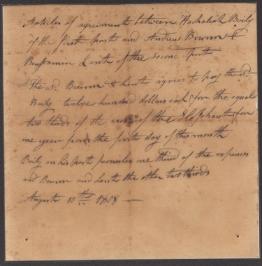
their willingness to pay for the experience. By 1808
his coffers were expanded to a point that he took on
two partners, Benjamin Lent and Andrew Brunn, each
paying $1200 for a one/third interest in The Elephant.
This document in the collections of the historical
society reads articles of agreement between
Hachaliah Bailey of the first part, and Andrew Brunn &
Benjamin Lent of the second part. The aforesaid
Brunn & Lent agree to pay the aforesaid Baily twelve
hundred dollars for the equal two thirds of the
earnings of the Elephant for one year from the first
day of this month. Baily on his part furnishes one
third of the expenses and Brunn & Lent the other two
thirds, August 13th 1808.
the Northeast. The first elephant had been imported
to America in 1796 by sea captain Jacob
Crowninshield, and was still being exhibited along the
eastern seaboard. Hachaliah purchased this second
elephant for a reputed sum of $1,000. She was
exhibited in the Hudson Valley in 1805 and in New
York City in 1806, which was possibly when Hachaliah
acquired her. She came to be called Old Bet,
perhaps in contrast to young Old Bet, his daughter
Elizabeth, born in 1805.
It has been said that Bailey intended to use the
elephant as a draft animal, like P.T. Barnum later did
at his Bridgeport, Connecticut estate, Iranistan, as a
publicity stunt. However, subsequent history suggests
that he developed grander ambitions for the elephant.
The story goes that he was shipped upriver on a
sloop, then walked to Somers, where Hach kept her in
the family barn. Bailey took Old Bet on the road and
quickly profited from her as a public attraction. They
traveled by night, stopping in barnyards and tavern
courtyards to show by day, charging twenty-five cents
admission. From his frequent trips to the cattle
markets of New York City, Bailey was familiar with the
tavern yard exhibition of animals. Realizing the public
fascination in viewing exotic animals, he cashed in on
their willingness to pay for the experience. By 1808
his coffers were expanded to a point that he took on
two partners, Benjamin Lent and Andrew Brunn, each
paying $1200 for a one/third interest in The Elephant.
This document in the collections of the historical
society reads articles of agreement between
Hachaliah Bailey of the first part, and Andrew Brunn &
Benjamin Lent of the second part. The aforesaid
Brunn & Lent agree to pay the aforesaid Baily twelve
hundred dollars for the equal two thirds of the
earnings of the Elephant for one year from the first
day of this month. Baily on his part furnishes one
third of the expenses and Brunn & Lent the other two
thirds, August 13th 1808.

| A Living Elephant, Lexington KY Reporter, Dec. 17 1808 Notice for display of the elephant Old Bet Reproduction, SHS collections |
| Agreement, August 13, 1808 Only a few years after acquiring her for the (speculated) sum of $1000, Hachaliah Bailey leased two-thirds of the use of “The Elephant� for one year to Andrew Brunn and Benjamin Lent, for $1200 each. SHS 74.3.1 The William & Nancy Bailey Collection |