| Brief History of the Town of Somers |
The town we call Somers was originally occupied by Kitchawanks, part of the
Mohegan tribe, who called the land Amapaugh, meaning fresh water fish. This land
was located in the eastern segment of an 83,000-acre tract that King William III of
England granted to Stephanus Van Cortland of New York City in 1697. The part of
Van Cortland Manor that ultimately became Somers and Yorktown was known as
the Middle District, or Hanover. Settlement in the Somers area began after Van
Cortlandt's death in 1700 and the final partition of his estate in 1734. Early
European settlers included tenants and freeholders from neighboring areas, among
them English, Dutch, French Huguenots and Quakers. It wasn't until March 7, 1788,
when the first town meeting was held at an inn, owned by Benjamin Green, that the
town named Stephentown was established. However, there already existed a
Stephentown in Rensselaer County. The resulting confusion, particularly in mail
delivery, lead to a change in the name to Somerstown and in 1808 to the Town of
Somers. The town was named as a tribute to Lt. Richard Somers, a young naval
officer from New Jersey who lost his life in the Tripolitan War. A memorial in West
Somers Park was erected in his honor at Memorial Day ceremonies in 1958.
The growth of Somers - In the early 19th century, Somers, or as it was then
generally known as Somerstown Plains, contained hat factories, carriage factories,
three hotels, two general stores, an iron mine, a milk factory, and a sanctuary for
boys operated by the Christian Brothers. There was a constant stream of goods and
passengers to large markets and cities through the village. As early as 1809, a
weekly newspaper was established, Somers Museum and Westchester County
Advertiser. Though primarily agricultural, the rural economy also supported a
varied population of weavers, preachers, merchants, cabinetmakers, doctors,
lawyers, teachers and servants. A good system of roads was maintained and some
operated as commercial toll roads. The railroad, developed in the 1840's, bypassed
the town of Somers, and affected a decline in growth over the next hundred years.
The presence of the railroad in nearby communities did allow the agricultural
emphasis to move towards dairy production and fruit growing, since the products
could be shipped to markets in the city.
Industries continued to thrive, with grist, paper, saw and clothing mills operating in
the area. Between 1890 and 1910, the Croton and Muscoot Rivers were flooded to
create the New York City Reservoir system thereby changing the local landscape
considerably. In the 1920's small lake communities began to spring up as vacation
havens for summer visitors and farmer's guests. These lake communities became
larger and firmly established, eventually evolving from seasonal to year-round
neighborhoods we now know as Lake Lincolndale, Lake Purdys and Lake Shenorock.
Following World War II, the rural countryside of Somers continued attracting
weekenders, many from New York City who became more mobile because of the
proliferation of automobile travel. The construction of Interstate 684 in the mid-
1970's facilitated a resurgence of residential and commercial development in
Somers for the next 20 years. The construction of the IBM and Pepsi Bottling
Group corporate campuses in the 1980's, coupled with the development of several
large-scale residential communities (Heritage Hills, The Willows), laid groundwork
for the Town to become a thriving bedroom community in the New York City region
with a distinctive corporate element.
Hachaliah's Elephant - In 1805 a farmer and cattle merchant named Hachaliah
Bailey acquired an Indian Elephant he named Old Bet, and she was one of the first
elephants to come to America. Although Bailey had planned to use the elephant for
heavy-duty work on the farm, the throngs of people who came to Somers to see the
elephant gave him the inspiration for showmanship on a large scale, and he began
exhibiting her throughout the northeast. His success in this venture attracted
numerous partners and rivals from local families, who joined in the business of
importing and exhibiting exotic animals. The resulting thriving menagerie business
paralleled the development of the circus in America, and by the 1830's the two
forms of popular entertainment merged to form the basis of the modern American
circus. In fact, the majority of early 19th century circus proprietors came from
Somers and neighboring towns in northern Westchester and Putnam counties. This
has led to Somers being titled "The Cradle of the American Circus."
The Elephant Hotel - In 1824, after Hachaliah's elephant was killed while on tour
in Maine, Bailey erected the Elephant Hotel to commemorate the elephant, which
had been responsible for his fortune. In 1827 he immortalized Old Bet with a
statuary likeness of her on the village green. Today it is stands as Somers' symbol
and is also part of the official seal of the Somers Town Government. Over the years
the building has functioned as an inn, a teahouse, a private residence, and a post
office. The Farmers and Drovers Bank, chartered in 1830 as the second banking
institution in Westchester, adjoined the Hotel, as did a major dance hall that was a
focal point of fun, frolic and business transactions for farmers, travelers, and hotel
guests. It soon became the economic and social center of Somers and the
surrounding area. Not only was it the meeting place for the menagerie and circus
owners, it was also a stagecoach stop for travelers between New York City and
points to the north and east. In 1835, the Zoological Institute was incorporated at
the Elephant Hotel. Between 1836 and 1939 The East Wing occupied the present
parking lot area, and increased the capacity of the Hotel to accommodate overnight
guests. It was in 1927 that the Town of Somers purchased the Hotel from the Bailey
family. The building now houses the administrative offices of the Town of Somers,
the Somers Historical Society, as well as a small museum chronicling the history of
the early 19th century American Circus and Somers. In 2005, the Elephant Hotel
was named a National Historic Landmark by the U.S. Department of the Interior.
Somers Hamlet, a National Register Site - Encompassing some 56 acres in
eastern Somers lies the Somers Hamlet, a mixed commercial/residential section of
town placed on the National Register of Historic Places in 2004. The Somers
Hamlet built up in the early nineteenth century as a turnpike center, and the historic
district, is aligned along the highway (US Route 202). A town center was created at
the western intersection where the Peekskill-Danbury Turnpike (US Route 202)
coming in from the west, and the Croton Turnpike (NY Route 100), coming in from
the south, merged.
The hamlet contains two pre-Civil War era cemeteries and numerous buildings
which remain as outstanding examples of 19th century rural architecture and
include the Elephant Hotel (ca 1825).
The 21st Century - As one of the fastest growing municipalities in Westchester
County, the Town of Somers has grown to exceed a population of 20,000 since the
2000 U.S. Census count of slightly more than 18,000. Nearly 100% of its 33 square
miles lies within the Croton Watershed of the New York City Reservoir System, a
fact punctuated by the abundance of spring fed lakes and streams. In looking to the
future, the Town strives to retain the rural character of its earlier years through
zoning, planning and conservation ordinances, either single-handedly or in
partnership with other public and private entities. In the late 1990's, the Town
increased zoning requirements to two- and three-acre zoning for many areas. In
partnership with New York State, Westchester County, the Watershed Agricultural
Council, and the Westchester Land Trust, the Town of Somers helped protect
Stuart's Farm, a 170-acre fruit, flower, vegetable and cut-your-own Christmas tree
farm in Somers, and the oldest working farm in Westchester County.
In a similar partnership, the Town acquired the 654-acre Angle Fly Preserve, an
historic, and one of the last natural, brook trout spawning streams in Westchester
County.
Mohegan tribe, who called the land Amapaugh, meaning fresh water fish. This land
was located in the eastern segment of an 83,000-acre tract that King William III of
England granted to Stephanus Van Cortland of New York City in 1697. The part of
Van Cortland Manor that ultimately became Somers and Yorktown was known as
the Middle District, or Hanover. Settlement in the Somers area began after Van
Cortlandt's death in 1700 and the final partition of his estate in 1734. Early
European settlers included tenants and freeholders from neighboring areas, among
them English, Dutch, French Huguenots and Quakers. It wasn't until March 7, 1788,
when the first town meeting was held at an inn, owned by Benjamin Green, that the
town named Stephentown was established. However, there already existed a
Stephentown in Rensselaer County. The resulting confusion, particularly in mail
delivery, lead to a change in the name to Somerstown and in 1808 to the Town of
Somers. The town was named as a tribute to Lt. Richard Somers, a young naval
officer from New Jersey who lost his life in the Tripolitan War. A memorial in West
Somers Park was erected in his honor at Memorial Day ceremonies in 1958.
The growth of Somers - In the early 19th century, Somers, or as it was then
generally known as Somerstown Plains, contained hat factories, carriage factories,
three hotels, two general stores, an iron mine, a milk factory, and a sanctuary for
boys operated by the Christian Brothers. There was a constant stream of goods and
passengers to large markets and cities through the village. As early as 1809, a
weekly newspaper was established, Somers Museum and Westchester County
Advertiser. Though primarily agricultural, the rural economy also supported a
varied population of weavers, preachers, merchants, cabinetmakers, doctors,
lawyers, teachers and servants. A good system of roads was maintained and some
operated as commercial toll roads. The railroad, developed in the 1840's, bypassed
the town of Somers, and affected a decline in growth over the next hundred years.
The presence of the railroad in nearby communities did allow the agricultural
emphasis to move towards dairy production and fruit growing, since the products
could be shipped to markets in the city.
Industries continued to thrive, with grist, paper, saw and clothing mills operating in
the area. Between 1890 and 1910, the Croton and Muscoot Rivers were flooded to
create the New York City Reservoir system thereby changing the local landscape
considerably. In the 1920's small lake communities began to spring up as vacation
havens for summer visitors and farmer's guests. These lake communities became
larger and firmly established, eventually evolving from seasonal to year-round
neighborhoods we now know as Lake Lincolndale, Lake Purdys and Lake Shenorock.
Following World War II, the rural countryside of Somers continued attracting
weekenders, many from New York City who became more mobile because of the
proliferation of automobile travel. The construction of Interstate 684 in the mid-
1970's facilitated a resurgence of residential and commercial development in
Somers for the next 20 years. The construction of the IBM and Pepsi Bottling
Group corporate campuses in the 1980's, coupled with the development of several
large-scale residential communities (Heritage Hills, The Willows), laid groundwork
for the Town to become a thriving bedroom community in the New York City region
with a distinctive corporate element.
Hachaliah's Elephant - In 1805 a farmer and cattle merchant named Hachaliah
Bailey acquired an Indian Elephant he named Old Bet, and she was one of the first
elephants to come to America. Although Bailey had planned to use the elephant for
heavy-duty work on the farm, the throngs of people who came to Somers to see the
elephant gave him the inspiration for showmanship on a large scale, and he began
exhibiting her throughout the northeast. His success in this venture attracted
numerous partners and rivals from local families, who joined in the business of
importing and exhibiting exotic animals. The resulting thriving menagerie business
paralleled the development of the circus in America, and by the 1830's the two
forms of popular entertainment merged to form the basis of the modern American
circus. In fact, the majority of early 19th century circus proprietors came from
Somers and neighboring towns in northern Westchester and Putnam counties. This
has led to Somers being titled "The Cradle of the American Circus."
The Elephant Hotel - In 1824, after Hachaliah's elephant was killed while on tour
in Maine, Bailey erected the Elephant Hotel to commemorate the elephant, which
had been responsible for his fortune. In 1827 he immortalized Old Bet with a
statuary likeness of her on the village green. Today it is stands as Somers' symbol
and is also part of the official seal of the Somers Town Government. Over the years
the building has functioned as an inn, a teahouse, a private residence, and a post
office. The Farmers and Drovers Bank, chartered in 1830 as the second banking
institution in Westchester, adjoined the Hotel, as did a major dance hall that was a
focal point of fun, frolic and business transactions for farmers, travelers, and hotel
guests. It soon became the economic and social center of Somers and the
surrounding area. Not only was it the meeting place for the menagerie and circus
owners, it was also a stagecoach stop for travelers between New York City and
points to the north and east. In 1835, the Zoological Institute was incorporated at
the Elephant Hotel. Between 1836 and 1939 The East Wing occupied the present
parking lot area, and increased the capacity of the Hotel to accommodate overnight
guests. It was in 1927 that the Town of Somers purchased the Hotel from the Bailey
family. The building now houses the administrative offices of the Town of Somers,
the Somers Historical Society, as well as a small museum chronicling the history of
the early 19th century American Circus and Somers. In 2005, the Elephant Hotel
was named a National Historic Landmark by the U.S. Department of the Interior.
Somers Hamlet, a National Register Site - Encompassing some 56 acres in
eastern Somers lies the Somers Hamlet, a mixed commercial/residential section of
town placed on the National Register of Historic Places in 2004. The Somers
Hamlet built up in the early nineteenth century as a turnpike center, and the historic
district, is aligned along the highway (US Route 202). A town center was created at
the western intersection where the Peekskill-Danbury Turnpike (US Route 202)
coming in from the west, and the Croton Turnpike (NY Route 100), coming in from
the south, merged.
The hamlet contains two pre-Civil War era cemeteries and numerous buildings
which remain as outstanding examples of 19th century rural architecture and
include the Elephant Hotel (ca 1825).
The 21st Century - As one of the fastest growing municipalities in Westchester
County, the Town of Somers has grown to exceed a population of 20,000 since the
2000 U.S. Census count of slightly more than 18,000. Nearly 100% of its 33 square
miles lies within the Croton Watershed of the New York City Reservoir System, a
fact punctuated by the abundance of spring fed lakes and streams. In looking to the
future, the Town strives to retain the rural character of its earlier years through
zoning, planning and conservation ordinances, either single-handedly or in
partnership with other public and private entities. In the late 1990's, the Town
increased zoning requirements to two- and three-acre zoning for many areas. In
partnership with New York State, Westchester County, the Watershed Agricultural
Council, and the Westchester Land Trust, the Town of Somers helped protect
Stuart's Farm, a 170-acre fruit, flower, vegetable and cut-your-own Christmas tree
farm in Somers, and the oldest working farm in Westchester County.
In a similar partnership, the Town acquired the 654-acre Angle Fly Preserve, an
historic, and one of the last natural, brook trout spawning streams in Westchester
County.
| Town of Somers History |
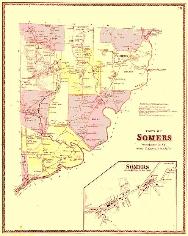
| 19th century map of Somers, Collection of Somers Historical Society |
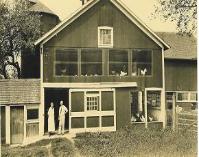
| Whitlock Farm, late 19th-early 20th century, collection Somers Historical Society |
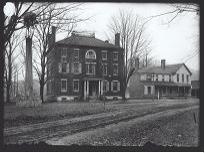
| The Elephant Hotel, late19th-early 20th century, collection Somers Historical Society |
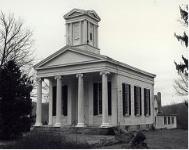
| St. Luke's Episcopal Church located adjacent to Bailey Park in the National Register District. |
 |  |